
Super.com's Operating Blueprint ⭐
Open Sourcing the actual OKRs and methodology that helped us scale from $0 to $200M+ in annual revenues

We’re really excited to be open sourcing the methodology, templates and actual OKRs (including real examples) that helped us scale from $0 to $200M+ in annual revenues.
Hopefully this blueprint can help many more startups and scale ups increase performance, grow faster and operate more efficiently. Enjoy!
Full OKR Sheet & Template link
What is an OKR?
OKRs have two important parts: The objective you want to achieve and the key results, which are the way you measure achieving the objective.
Objectives: are memorable, qualitative descriptions of what you want to achieve. Objectives should be short, inspirational, and engaging. An objective should motivate and challenge the team.
Key results: are a set of metrics that measure your progress towards the objective.
The primary goal of OKRs is to ensure we are all moving in the same direction and executing on our strategy.
Why do we use OKRs?
Greater alignment: Everyone is on the same page about goals and success indicators
Increased focus: OKRs are thoughtful and well-defined, which boosts focus on the goals that really matter
Boosted accountability: Everybody knows exactly how success will be measured and who is responsible for making it happen
Improved flexibility: Since OKRs are set quarterly, those shorter goal cycles allow more wiggle room and improve our ability to move fast
How to write OKRs?
Objectives “O”
Objectives are clearly defined goals of how we achieve our mission/vision.
Generally short, bold, inspiring and not measurable.
Keep highly focused with a max of 3 objectives per vertical tab and 2 per MAT tab.
1 stable objective quarter-to-quarter for MAT teams, 1 objective should align to the North Star / Mission of the MAT and not change quarter-to-quarter, with up to 3 KRs
Sort highest priority to lowest (P0, P1, P2)
Key Results “KR”
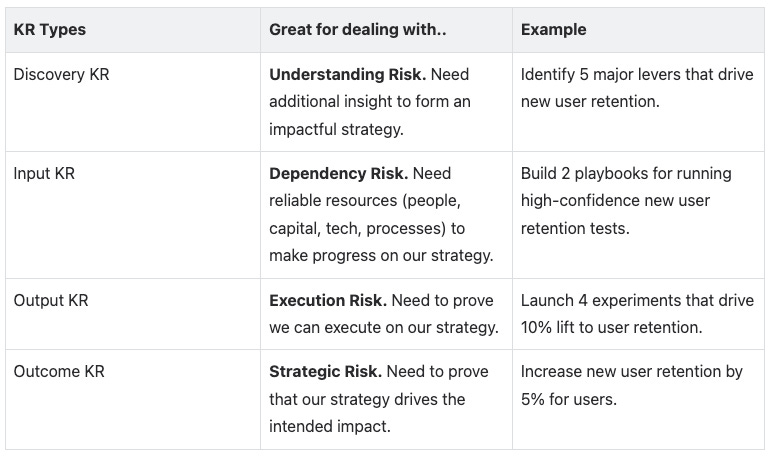
The four types of KRs (inspired by NCTs): Discovery, Input, Output, Outcome
Regardless of KR type, KRs should be measurable (include a number) and tied to the objective
Keep highly focused with a max of 3 KRs per objective
Sort highest priority to lowest (P0, P1, P2)
Four Types of KRs
How to review OKRs?
Purpose
The purpose of the monthly OKR process is to align stakeholders, build awareness of the initiatives and progress against them, and make decisions about prioritization & tradeoffs to ensure we achieve the OKR’s that were established at the start of the quarter.
Pre-Work
2 days prior to the meeting, individual KR owner’s are responsible for providing a pre-read column for the relevant month along with their OKR progress / status. If team members are on vacation, they should provide an update before departing or delegate this responsibility within their team.
OKR Reviews
OKR reviews begin with a silent reading period and should have someone facilitating the meeting so key takeaways and discussion points are captured.
While pre-read’s should be populated in advance, due to vacations and other priorities sometimes they are not populated until the day of, hence why a reading period is needed. During silent reading periods, stakeholders should add any questions to the discussion notes with their name in brackets to be addressed during the discussion period.
The goal of synchronous OKR reviews is not to go line by line through the status of every OKR. The goal of pre-reads and reading periods is to bring everyone up to speed and accelerate the time commitment, and focus only on the tagged areas of discussion.
Any OKR that has a changed status of “Unsure” or “Not On Track” should be discussed, as well as any OKR’s with comments in the discussion periods. Action Items should have clearly assigned owners in the discussion notes that can be reviewed in the next OKR review.
Super.com’s OKR Process
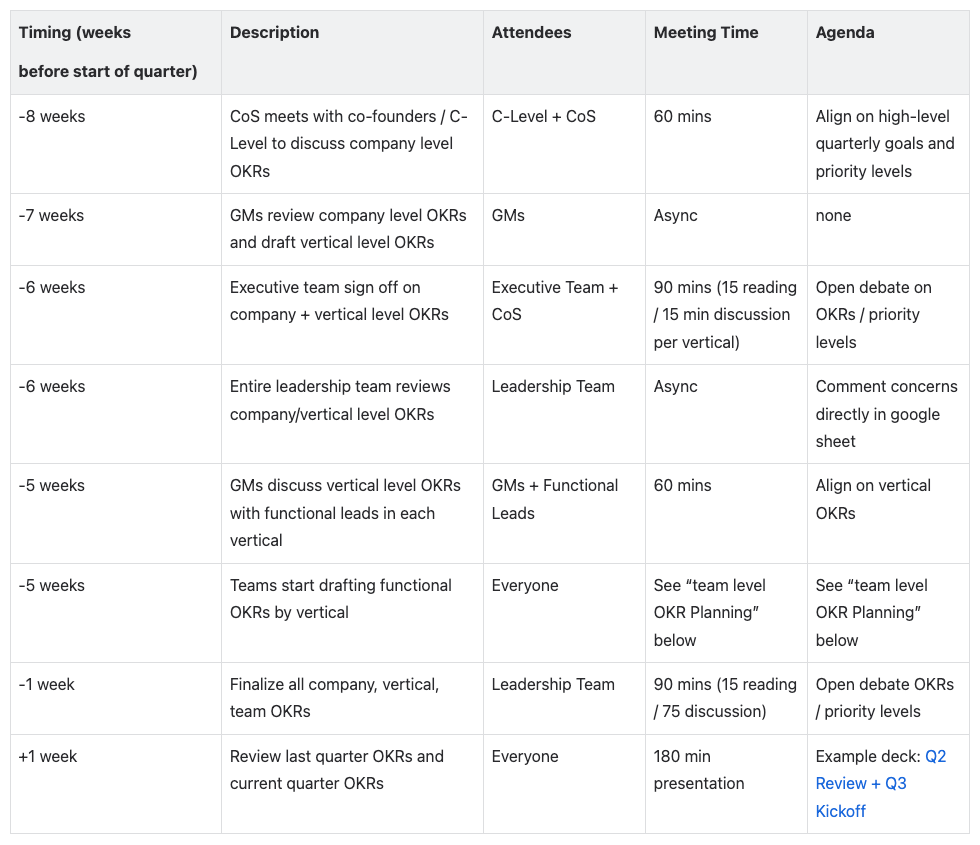
Company / Vertical Level OKR Planning
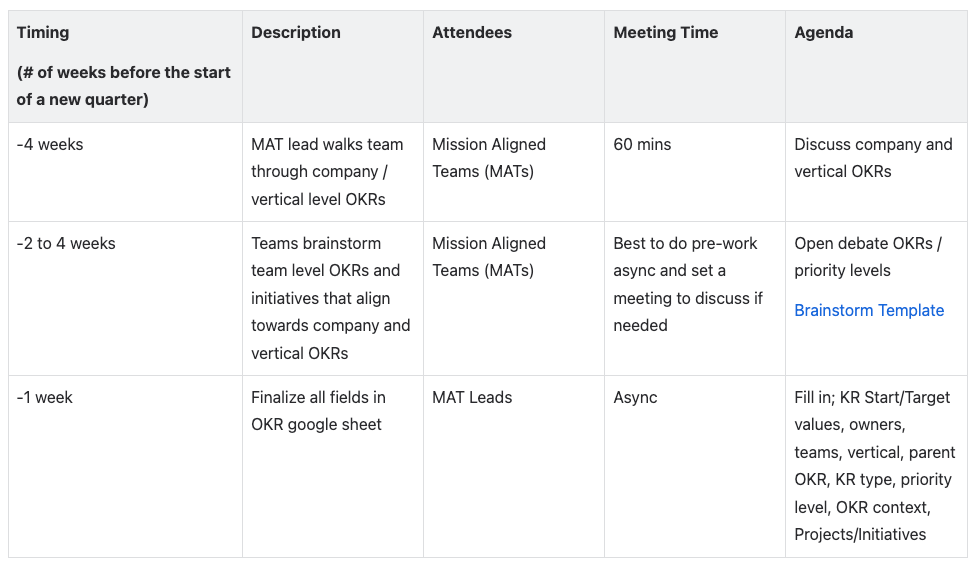
MAT / Team Level OKR Planning
The OKR Google Sheet
Menu
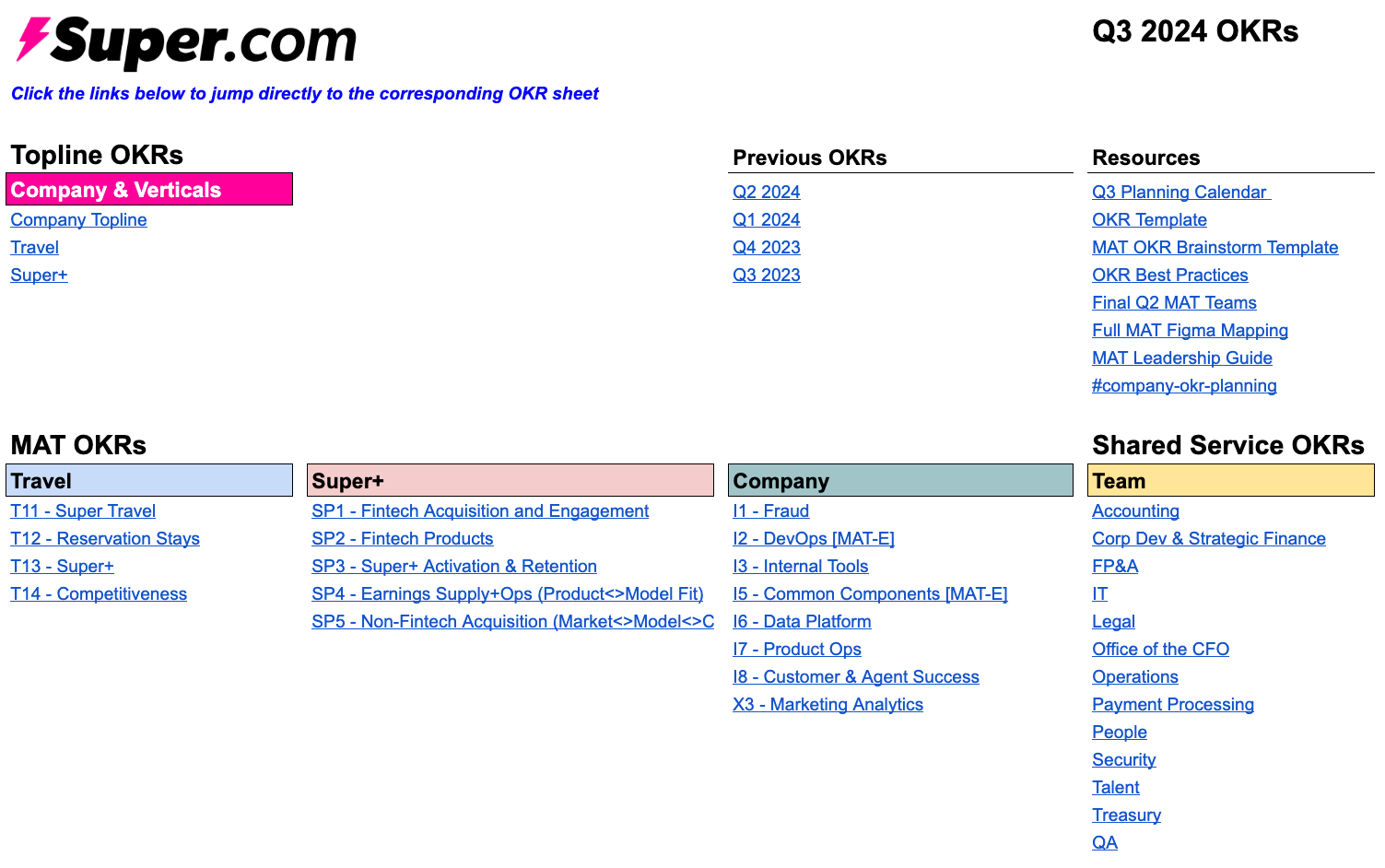
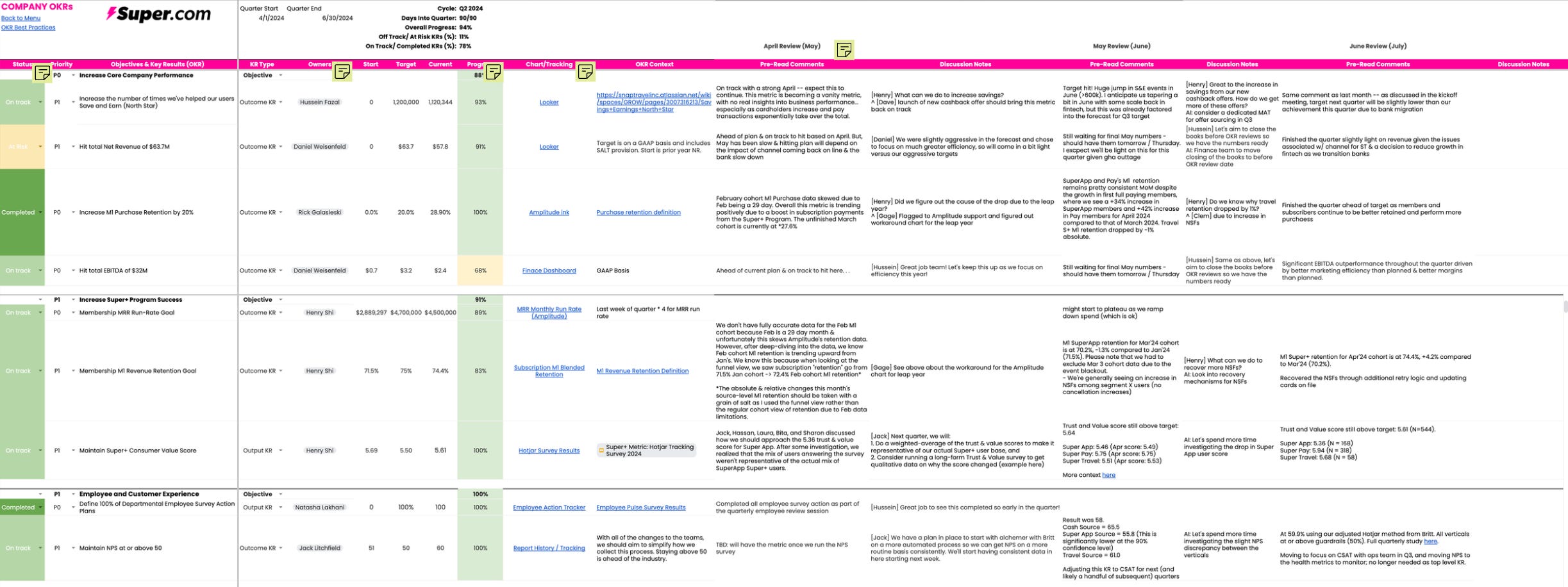
Company OKRs
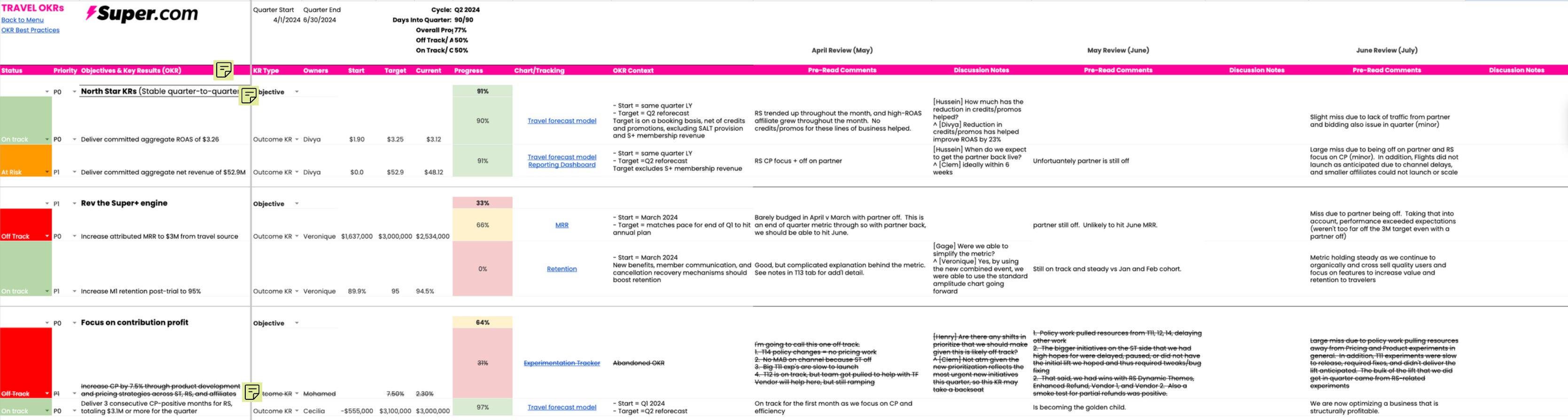
Travel Vertical OKRs
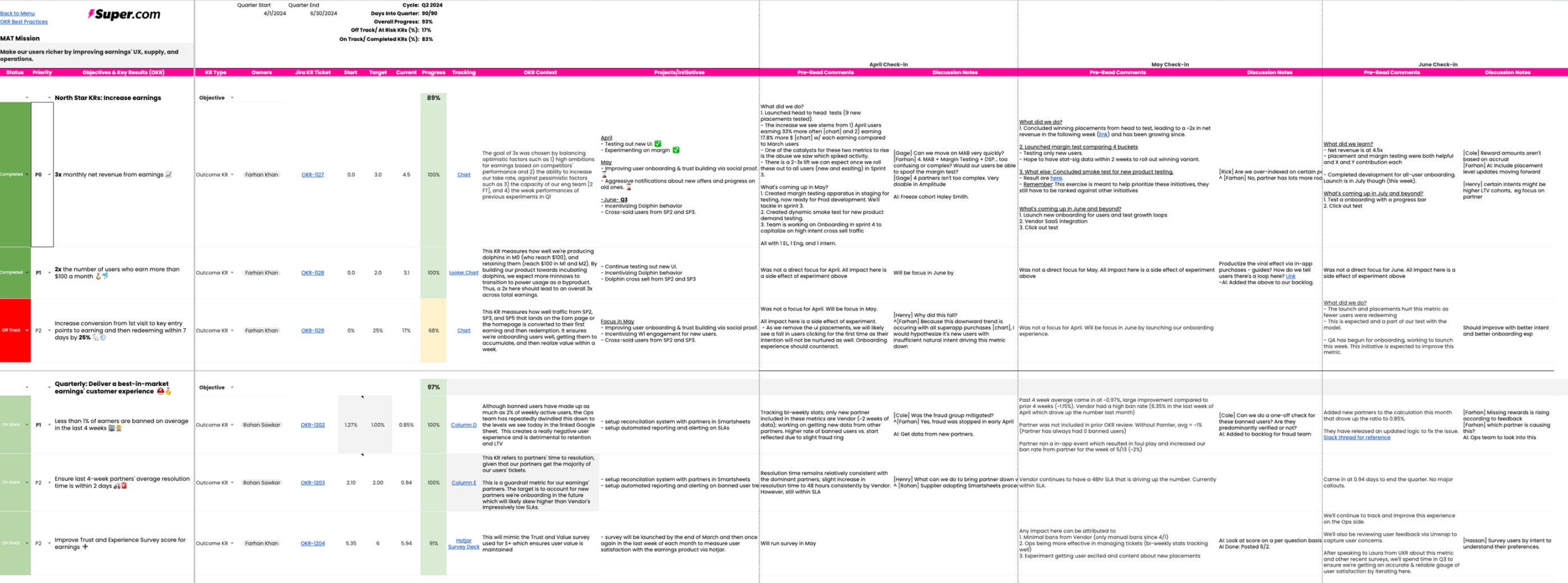
Earnings MAT OKRs
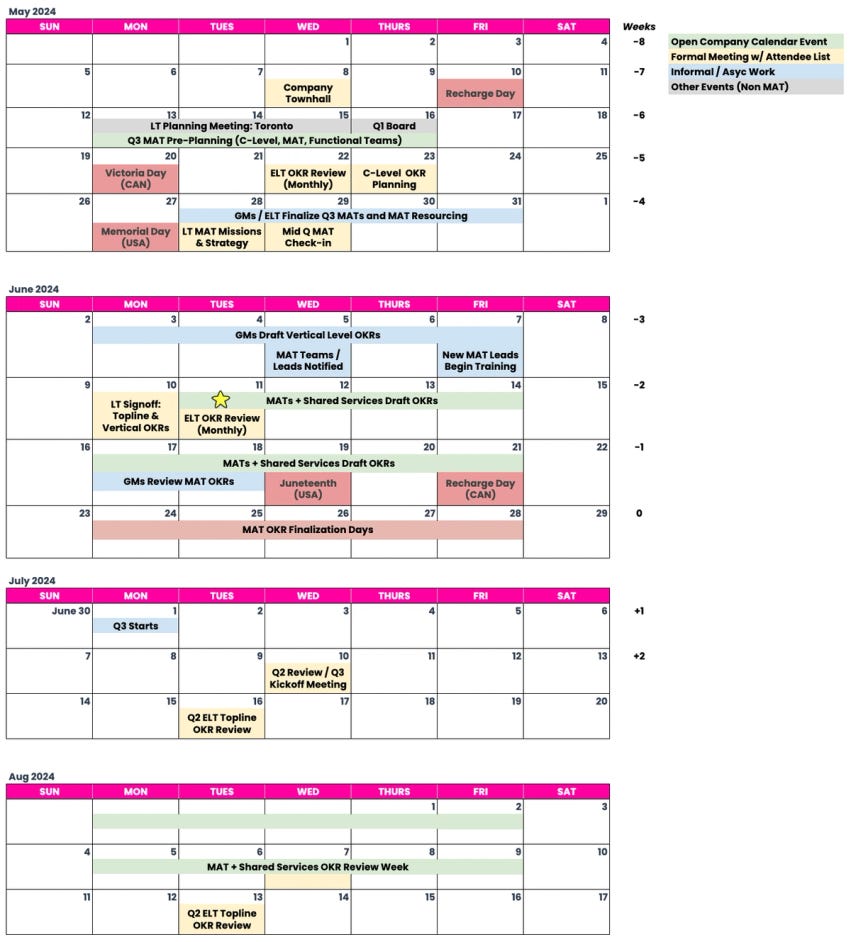
Q3 OKR Planning Calendar
Reviewing and Updating OKRs
Fill in all KR current values, Status and Pre-Read Comments on a monthly cadence
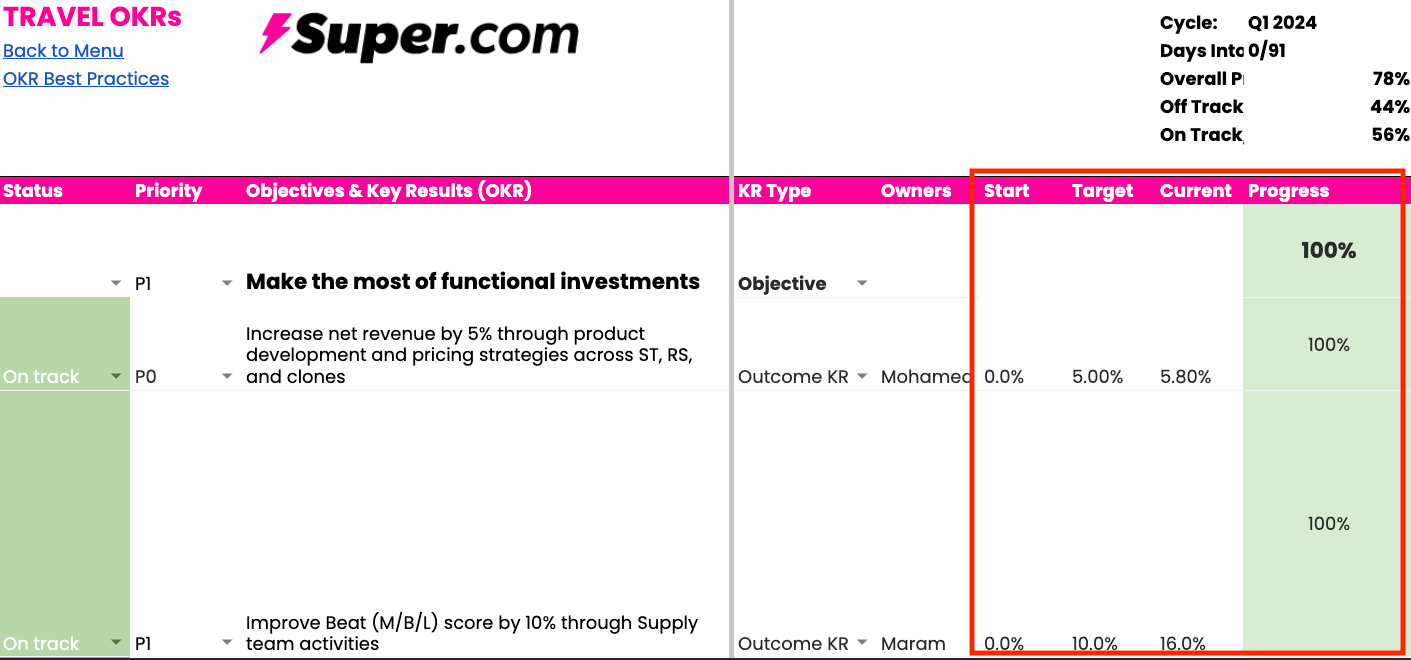
Do not edit OKRs mid quarter
It’s ok to reprioritize or abandon OKRs based on resourcing, external and internal factors, but do not change targets
No OKR juicing
Example: “Launch 3 partners” means actually launching to production not just signing 3 contracts and finishing development but not shipped
Multi-quarter OKRs are okay
Can be helpful to leverage NCT KRs (discovery → outcome)
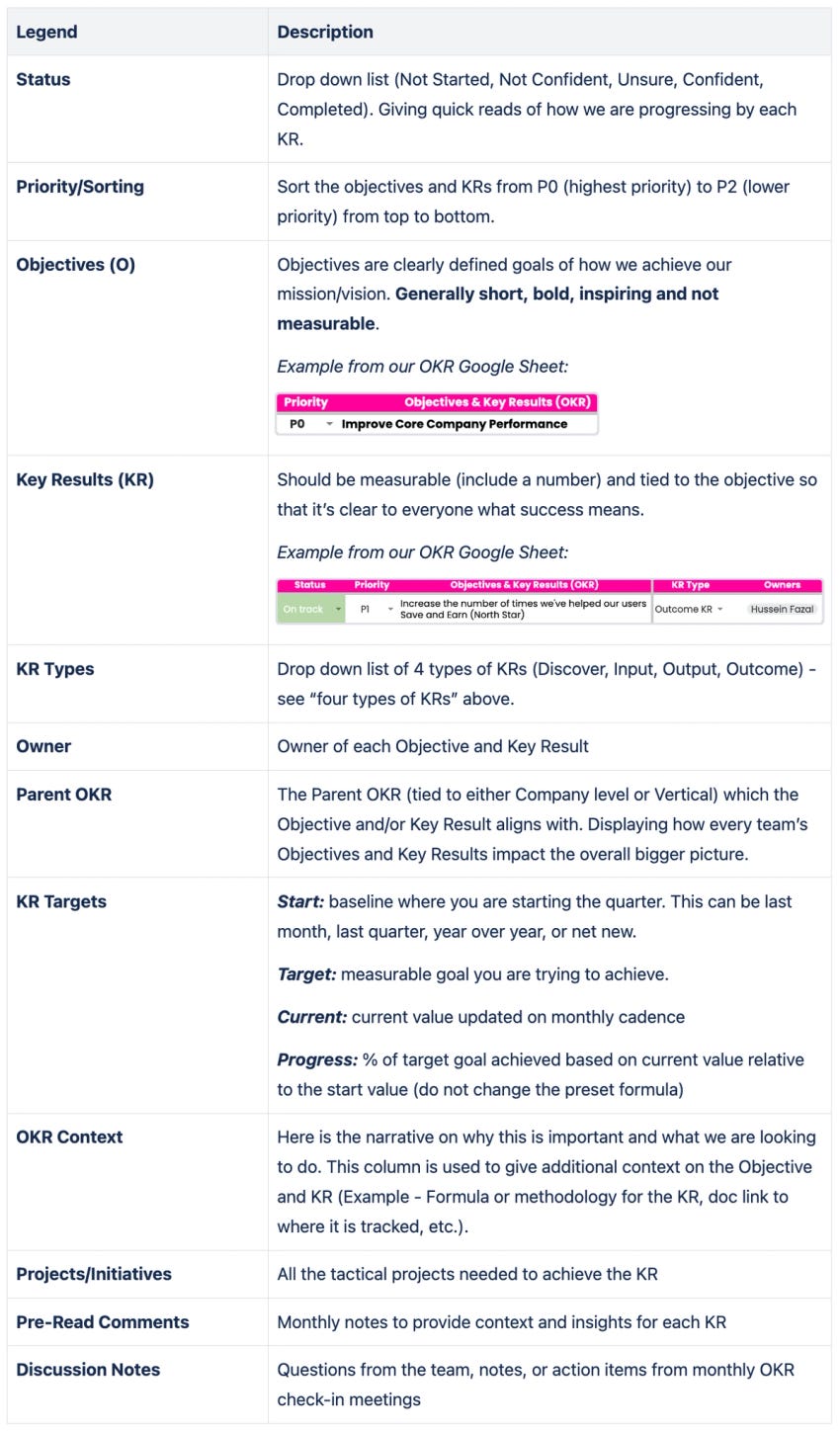
Appendix: OKR Legend
https://open.substack.com/pub/countfrogula/p/frogulalabsai-presents-the-dawn-of?utm_source=share&utm_medium=android&r=5i67hn
Would be super helpful to have a template of this.