
The Private Delegation System Behind Billion-Dollar Founders
For the first time ever, a $1B founder is sharing the private systems he’s spent years and millions building

I had a very interesting conversation that changed how I think about delegation.
The man sitting across from me co-founded Polymath (raised $59M, hit $1B token market cap), Polymesh (one of the best-performing L1 blockchains of 2024), took two companies public (Tokens.com in 2021, Matador in 2024), and currently runs Sapien (raised $10.5M in 2024).
When I asked him about his $300K+/year support infrastructure, he told me straight away it’s the best ROI he’s ever gotten.
This is Trevor Koverko’s delegation framework: the system elite founders build in private but never discuss publicly.
So I’m giving you his complete playbook: the team structure, the exact costs, the exact SOPs and workflows, the tools, and the step-by-step process to build your own version starting with just $10/hour.
For context: His head EA spent hours walking me through documents and Trevor’s delegation framework, which they’ve never shown anyone outside their inner circle.
And yes, I am sharing the actual SOPs at the end (120+ pages).
The Productivity Trap That Silicon Valley Won’t Admit Exists
Silicon Valley worships a narrative that sounds heroic but is actually toxic: Do everything yourself, stay in the weeds, be in the details, and grind harder than everyone else.
Trevor bought into this completely when he started his first company in college.
He left school early, moved to a different country, and threw himself into the founder lifestyle with intensity. For years, he wore his operational intensity like a badge of honor.
Then reality hit.
Context switching between small tasks was destroying his ability to focus on core problems. Administrative work consumed hours that should have been spent on strategy, product, and growth.
Until one day, he realized he was spending more time managing logistics than building his company.
So he made a decision that felt uncomfortable: he hired one virtual assistant he could barely afford. That changed the trajectory of his entire career.
From One VA to a $300K Support System (And Why Each Addition Paid For Itself)
Trevor’s support system evolved organically, driven by one simple principle: Every time he added support, he got measurable ROI through time savings, peace of mind, or increased capacity.
Trevor was able to reclaim 10–15 hours/week by offloading inbox triage, scheduling, follow-ups, and prep
His support system was able to process 150+ emails/day without his involvement and he was able to dedicate 2-6 hours/day for deep work.
So he kept adding.
The Head of Everything: Lauren
She’s been with Trevor for almost 10 years. Started as an executive assistant and has now evolved into a Chief of Staff role.
Annual compensation: $120K/year.
She has complete access: Full banking access, personal matters, confidential business information.
But her most important role is routing.
Trevor calls it the brain dump system. He sends unorganized thoughts, messy task lists, and stream-of-consciousness needs to one place.
Lauren’s job is to parse that chaos and assign tasks to the right specialists.
Offshore VAs at $3-4K/Month:
Multiple virtual assistants, primarily based in the Philippines.
Each VA specializes:
One focuses on bookkeeping, numbers, and financial tasks
One handles face-to-face meetings and errands
One manages vendor relationships and negotiations
One provides 24/7 coverage by staying on Philippines hours
2 PAs (In-Person) in Toronto at $10K/month
These are in-person roles focused on daily life management.
Requirements: Must have a driver’s license, must be high-trust, and must handle personal logistics seamlessly.
Annual compensation: $5k/month.
Responsibilities include food management, laundry, cleaning, errands, and any tasks that require physical presence.
Trevor learned a critical lesson that you need coverage redundancy.
One PA is good, but when that PA goes on vacation, gets sick, or travels for business, you are back to handling everything yourself.
So one became two, then two became three. It sounds excessive until you realize every additional human AI (they combine human intelligence and use AI tools) delivers ROI.
The $40K Employee That Feels Like a $120K Executive
Trevor realized that a $3-4K/mo offshore EA with AI feels like a six-figure employee. This is a massive arbitrage opportunity that many ignore.
Most founders I know drop the idea of an EA, thinking high-end executive assistants in NYC or SF cost $80-120K+/year. But in reality, an offshore EA at $3-4K/mo, properly trained and equipped with AI tools, delivers comparable or superior output.
Trevor’s EAs use AI to:
Research vendors and draft negotiation responses
Transcribe and organize voice memos into Asana tasks
Enhance administrative capabilities across the board
Predict needs and optimize proactively
The training process:
Stage 1: Execute specific tasks as assigned
Stage 2: Predict needs before being asked
Stage 3: Proactively optimize systems and workflows
Most founders never get past Stage 1 because they don’t invest in training. Trevor invested heavily in teaching his EAs to think like him, and that’s where the actual ROI is.
Everything Done Twice Gets a Procedure (No Exceptions)
Trevor has a non-negotiable rule that most Silicon Valley founders don’t follow: Everything done more than once needs a documented procedure.
I immediately asked him, “Doesn’t that add friction?” He said he believes that you need to make everything that’s done more than once systematic.
He has SOPs (Standard Operating Procedures) for everything:
Vendor selection process
Property renovation workflows
Reference check systems
Relationship building with vendors
Pricing negotiation frameworks
Example: When Trevor does a property renovation, his team follows a step-by-step process.
How to identify potential vendors, how to get references, how to negotiate pricing without damaging relationships, and how to use AI to research and draft responses.
The process is documented, tested, and repeatable. This means Trevor doesn’t need to be involved in execution. The system runs without him.
His EAs know exactly what to do because the playbook already exists.
The SOP System That Runs Trevor’s Operations (Without Him)
Lauren showed me their key operations centre during our follow-up call.
She pulled up their Asana workspace, and what I saw was hundreds of SOPs, meticulously organized, constantly updated, and instantly accessible to everyone on the team (on a need-to-know basis).
How the System Works:
The idea is to organize it by team and location: Travel SOPs live in one section, HR processes in another, and accounting workflows in a third.
If you are the Toronto-based PA, you don’t need to see the Barbados property management procedures.
If you are handling investor relations, you don’t need access to personal chef meal prep instructions.
The system surfaces exactly what you need when you need it.
Every SOP is tagged with the Master SOP for searchability. This prevents confusion between the procedures and one-off tasks on the same topic.
The tagging system creates instant access to institutional knowledge.
What makes this system brilliant:
It’s designed for someone who knows nothing.
Lauren’s principle:
You have to act as if somebody has no idea what you are talking about. You have to make it so clear that they can read it, come in knowing nothing, and be able to understand what’s happening.
This is the documentation for your future replacement.
What’s Actually in These SOPs:
Trevor’s complete delegation framework and SOPs include:
• Daily, weekly, monthly, quarterly, and annual assistant SOPs
• Calendar architecture and color-coding system
• Meeting briefing templates for first-time meetings
• Hiring, onboarding, and offboarding procedures (with interview questionnaire)
• Chef and meal prep coordination system
• Travel checklists and packing SOPs
• Health and nutrition routines
• Property management operations
• SOP for creating SOPs
• Asana best practices and task naming conventions
• Service provider booking and payment workflows
If Lauren left tomorrow and someone new stepped in, they’d find:
Where the keys are to check the mail
What food Trevor likes when placing repeat orders
Which accounts they have access to, and at what level
Who to contact for different types of requests
Step-by-step accounting procedures with specific details
Everything Lauren knows is documented.
New team members get assigned the relevant SOP tasks in Asana. Questions that used to require real-time responses now have documented answers.
Even experienced team members use SOPs for tasks they do regularly.
The documentation becomes a quality control mechanism.
The Upfront Cost vs. The Forever Payoff
Lauren admitted that SOPs can initially be time-consuming to generate because you have to sit there and think out step by step. But the long-term payoff is undeniable.
Communication becomes clearer because everything is in writing. Onboarding becomes faster because new hires have structured training materials. Operations become more consistent because everyone follows the same playbook.
The upfront cost in time generates downstream efficiency gains forever.
The Meta-Move: An SOP for Creating SOPs
The most brilliant part of Trevor’s system is that they have an SOP for creating SOPs.
It covers:
How to title SOPs for easy discovery
How to organize information clearly
How to keep procedures clean and scannable
How to use Asana’s features for maximum efficiency
This meta-documentation ensures consistency across all procedures.
New team members creating their first SOP are not guessing the format or structure. The template already exists.
An Example of A System in Action: The Hiring SOP
When Trevor needs to make a new hire, the documented process flows like this:
Trevor opens a new role request
Task goes to the recruiting and hiring team
HR lead drafts the job description
Description goes to Trevor for approval
A separate Asana project tracks all candidates
Each candidate gets their own task with all notes and interview feedback
If multiple people interview a candidate, all notes live in one centralized location
Post-hire: Onboarding checklist triggers automatically
Every step is documented, every handoff is clear, and nothing falls through the cracks.
Security Built Into the System
One SOP has the master list of who has access to what accounts: Admin access, user access, and billing access. Everything is documented with names attached.
This serves two purposes:
1. If you need something done in a specific system, you instantly know who to contact.
2. It provides oversight on security and cost. You can see exactly how many paid seats you have in each tool and ensure you are not paying for unused accounts.
How SOPs Make Every Team Member Replaceable (In the Best Way)
This is the real genius of Trevor’s SOP system.
When someone leaves, their knowledge doesn’t leave with them. When someone joins, they are productive in days. When Trevor needs something done, he doesn’t need to explain it from scratch every time.
The system is the memory, and the documentation is the intelligence.
Trevor’s team members become interchangeable parts in the best possible sense because the organization’s capabilities don’t depend on any single person’s memory.
How Trevor’s EAs Schedule Everything (Without Ever Asking Him)
Trevor showed me something during our call that most founders would consider giving away too much control.
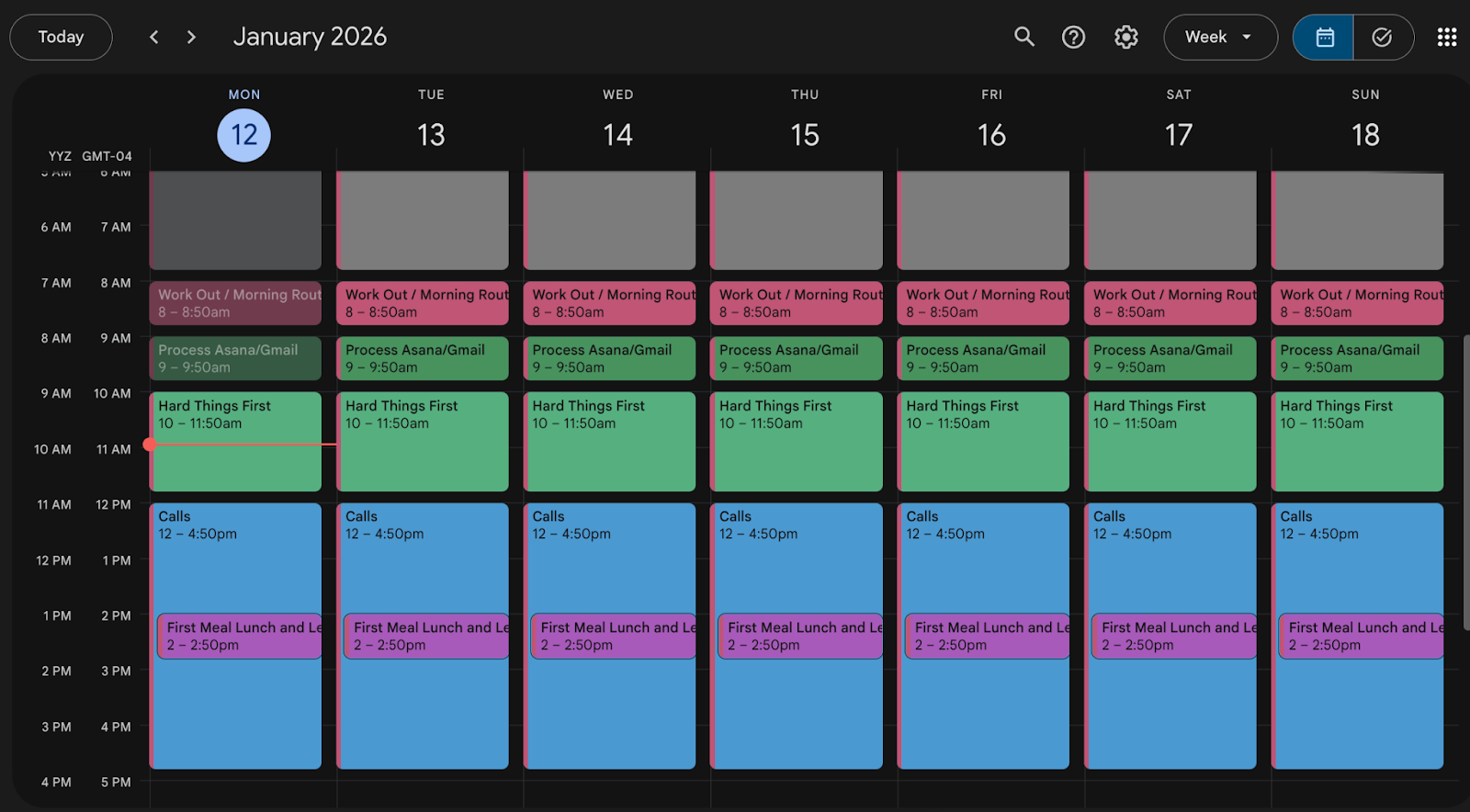
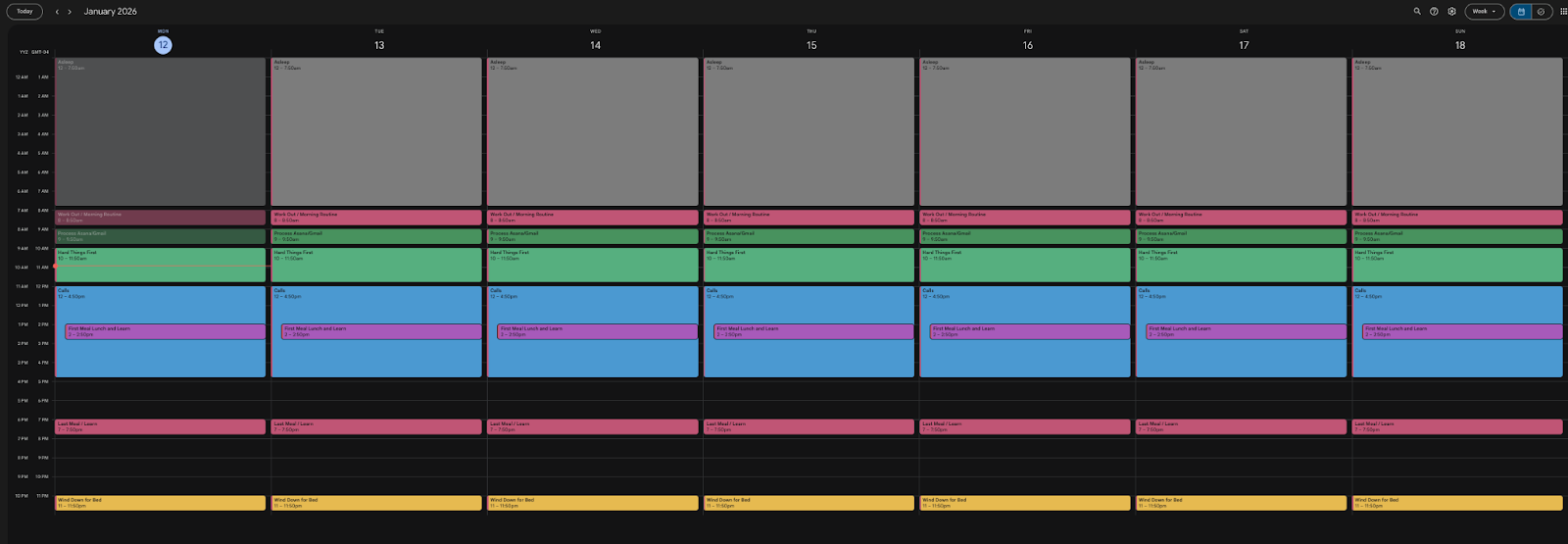
He pulled up his calendar architecture: a custom visual system that serves as the key to his productivity.
The system is deceptively simple but quite powerful.
His EAs know:
When calls should be booked (and when they absolutely shouldn’t be)
When distraction-free deep work time is protected
When meals should be scheduled and what they should contain
What types of meetings belong in which time blocks
This is a flexible framework that guides decision-making.
When someone requests a meeting, the EA doesn’t need to ask Trevor. They know where it fits based on the architecture.
The rules are specific: 25-minute bookings, back-to-back, with no gaps in between. Calls are color-coded by type (Sapien calls in blue, Polymath in a different color). Recurring calls follow a weekly rhythm: HR calls are always on Thursdays, accounting on Wednesdays.
Trevor also uses another system inspired by Dan Martell: EA-managed email. The EA sorts incoming emails, prioritizes them, and drafts responses. Trevor just needs to do a quick review and send.
The core principle is to push yourself beyond your comfort zone with delegation.
The Three-Step System: Voice → Zapier → Asana → Done
Anything on Trevor’s mind gets dumped into a voice memo. Zapier automatically populates those voice memos into Asana. The system transcribes, sorts, prioritizes, and sets deadlines.
The EAs manage follow-ups and ensure nothing falls through the cracks. This workflow does three things simultaneously:
Captures thoughts instantly without breaking flow
Converts unstructured thinking into actionable tasks
Removes the mental burden of remembering everything
Trevor estimates this saves him multiple hours per week while ensuring nothing important gets lost.
The beauty is in the automation. He’s not manually creating tasks, organizing his thoughts, or setting his deadlines. He just speaks while the system handles the rest.
The Mental Horsepower Theory (And Why Grocery Shopping Could Be Killing Your Business)
Trevor believes that you only have so much mental horsepower to make decisions each day, and small decisions burn that capacity. When you face a big, important decision later, you are already burnt out.
This is why he systematically eliminates small decisions from his life.
He learned it the hard way during his early days as a founder, when he saved money by doing his own grocery shopping and was proud of himself for that.
But his mentor told him it was not worth his time, as it was well below his per-hour rate.
Today, Trevor believes that everyone, including Elon Musk, has a figure for what their time is worth per hour.
You need to calculate yours and then ruthlessly eliminate tasks below that threshold.
Teaching Them to Think Like You (The Hardest Part That Creates 10x Returns)
This is the hardest part of the entire system (also the most important).
Getting an EA to execute specific tasks is relatively easy, but getting them to think like you, predict your needs, and proactively optimize your life is a major unlock.
Trevor’s approach:
1. Shadow you extensively
Let them observe your decision-making in real-time. Let them see why you are making the choices you are making.
2. Give explicit permission to think like you
This sounds obvious, but most founders never really empower their EAs to think independently. You have to explicitly say: I want you to think like me and make decisions on my behalf.
3. Give them rope to fail
The iterative process is essential. They’ll make mistakes, and that’s how they learn.
4. Instant, direct feedback
As soon as you have feedback, give it. Trevor calls this a precious gift that EAs crave. The communication must be clear, direct, and concise for this to work.
5. Silicon Valley empowerment approach
Don’t micromanage constantly. Give them objectives and let them fill in the blanks on execution.
Trevor prefers yes/no questions and fill-in-the-blank formats. This forces the EA to think through options and present solutions.
Your First Hire: The $10/Hour VA That Starts the Flywheel
I asked Trevor the question you are probably thinking: What should someone making $500K+/year do first?
Step 1: Start with a virtual EA to shadow you
Don’t wait until you can afford a Chief of Staff. Find someone on Upwork for $10/hour if needed. Have them shadow your work and identify patterns.
Step 2: Document everything
As they observe, start creating SOPs for repeated tasks. This documentation becomes the foundation for systematic delegation.
The initial time investment in creating SOPs feels significant, but the long-term efficiency gains are exponential.
Every documented procedure saves time forever.
Step 3: Build trust incrementally
Be careful with bank accounts and privacy initially.
Use tools and systems before giving full access. Build trust over time as the EA proves reliable.
Step 4: Err on the side of over-delegating
Push outside your comfort zone. Over-delegate, if needed, but never under-delegate (what most founders do).
Step 5: Calculate your per-hour worth
Then ruthlessly eliminate everything below that threshold. Here’s how you can calculate yours:
If you are self-employed:
Hourly Rate = (Desired Profit + Desired Salary + Operating Costs) ÷ Income-Producing Hours
If you are an employee:
Hourly Rate = Annual Salary ÷ (Hours per Week × Weeks per Year)
Everything below that number should qualify for automation, delegation, or deletion.
The Compound Returns of Personal Infrastructure
When I asked Trevor about ROI, his answer had two parts.
Qualitative returns: Priceless
Peace of mind: Priceless
Happiness: Less administrative work = more happiness
Health: Optimized nutrition and reduced stress
These can’t be quantified in traditional terms, but they are arguably the most valuable returns.
Quantitative returns
But Trevor’s estimate is that the $300K+/year investment delivers a very high ROI (a no-brainer investment)
Evidence:
Scalability of projects (can pursue multiple ventures simultaneously)
Breadth of projects (wider range of opportunities)
Intensity within a single company (deeper execution without administrative drag)
And the returns compound over time, just like great venture investments.
The Action You Should Take Today
Trevor’s final advice: Get a $10/hour EA tomorrow.
Start with Upwork if you need to, or use a platform like Athena (Trevor’s hired dozens of EAs through them over the years).
Trevor believes you should hire fast and fire fast for this role.
Look for a taskmaster who loves spending 8 hours a day on boring admin tasks. Ensure they are in your time zone (key), and look for early signs of HYPER organized, proactive, detail-oriented (must be a 10/10 for taking direction).
Look for high trust and the right personality fit (run personality tests early). Spend face time with candidates before diving into the weeds. (Sample interview questionnaire shared by Trevor in the footnote)
Then start small, build systems, and document processes. Train them to think like you.
The arbitrage opportunity of offshore EA + AI is massive right now.
Don’t wait until you are overwhelmed to build support infrastructure. Start before you desperately need it.
This delegation framework is the engine that enables ultra-successful founders.
Most founders would never share this level of operational detail. It’s too valuable, too proprietary, and too much of a competitive advantage, but Trevor’s doing it anyway.
